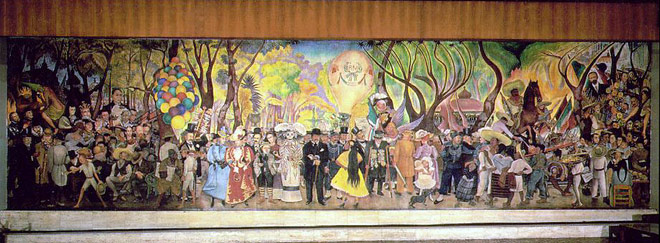
I dont think this mural has to do with Mexican History or so much as it's whole Identity, I do still believe it is a time line though. I think what Rivera wanted to do was to glorify and romanticize the ideals of the revolution. To further show this point he had to start from the darkest point in Mexican's history as a starting point to contrast and where in history they have progress to the where they are now and how they made it out of the dark time. If Rivera had started from the indigenous people, the effect of the painting would be a mash up of light to dark to light to who knows what. What I think was important was to show the beauty and AMAZINGNESS of the revolution and that is what is the important factor of this mural which I believe is a timeline to compare and contrast the bad from the good and why the Mexican revolution was successful, not so much identity or overall history of Mexico.
Not sure if I'm 100% confident with that answer, but it helps me sleep at night, LOL! :D everyone be safe and have fun during spring break... can't wait!

Stephanie:
ReplyDeleteI really appreciate this posting. It makes sense to think that Diego Rivera wanted his mural to start with what he considered “the darkest” period in Mexican history and would end with the Mexican Revolution. I’m glad that you dismissed all other explanations (including my own :) and you kept on pondering this question in your head until you arrived to such a convincing interpretation. It shows how much you’ve grown as a critical thinker. Keep up the good work!
Stephanie,
ReplyDeleteI was also confused about why a mural about the history of Mexico would start with white people instead of the indigenous people who had lived there thousands of years before the white people discovered it. I don’t think he did it to make the white people who would see it at the hotel happy either. It is very interesting that the left side of the mural is much darker and the right side with the revolution seems much brighter and more colorful. I think you’re right; I think it does glorify the Mexican revolution. Much of the mural depicts characters from the revolution. I think he wants to show the progress that Mexico has made and the benefits of the revolution by depicting the revolution as a bright, important, positive event. Great analysis!
Great post! I agree with what you are talking about with that the dark side represents the Spanish intervention, and the lighter side is 100% the revolution and what the revolution is supposed to represent. I disagree that the post deals with the mexican history because of where some people are placed in relation to a time line. I think that it is the mexican identity and that they can't forget about one side of their history that is there and will always be there, they may not embrace it but it is a reminder that that side of their history does exist.
ReplyDelete